From Civilizational Wisdom to a Shared Future

-

China moves swiftly to stabilize markets amid global financial turbulence
In a time of heightened uncertainty in the global trade environment and dramatic fluctuations in international financial markets, the timely and decisive action of China's state capital will effectively guide market expectations and mitigate the impact of external shocks.
2025-04-09
-

China to work with EU to promote sound, steady development of relations -- Premier Li
Protectionism leads nowhere, and only openness and cooperation represent the right path for mankind.
2025-04-09
-

Practical progress in bilateral ties urged
The talks came close on the heels of the meeting between President Xi Jinping and Indian Prime Minister Narendra Modi in Kazan, Russia, held less than a month ago. The meeting was described by Wang as a restart of bilateral ties.
2024-11-21
-

Beijing Hosts the Third International Forum on Democracy
The third International Forum on Democracy: The Shared Human Values, kicked off in Beijing on Wednesday. Over 200 guests from various countries, regions, and international organizations engaged in discussions to explore the essence of democracy and paths for mutual learning.
2024-03-20


By Rakesh Kumar
India and China are two of the world’s oldest living civilizations and share humanistic values at their core. Both civilizations adhere to traditional values in which the interests and comprehensive development of the collective are important guiding principles in their societies. Asian civilizations, which place great value on humanity and nature, have developed distinctive cultural traditions and ways of understanding the world. Rather than viewing the world through a single or absolute lens, Asian thought often recognizes that different perspectives can lead to different understandings. This openness to different perspectives and approaches resonates with the Indian philosophy of Vasudhaiva Kutumbakam — “the world is one family,” which emphasizes inclusiveness, coexistence, and the interconnectedness of humanity.
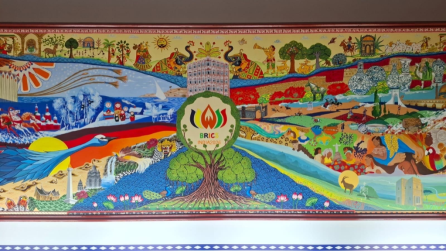
The thematic mural at Bharat Mandapam, the main venue of the 18th BRICS Summit in New Delhi, brings together artistic traditions from BRICS countries, symbolizing friendship and a confluence of cultures.
A Shared Civilizational Heritage
China and India are both ancient civilizations with a history of several thousand years. The history of exchange between these two Asian giants is also more than two thousand years old. Buddhism, which emerged in ancient India, was introduced to China during the Eastern Han Dynasty (25-220 CE) and gradually merged with traditional Chinese culture. The spread of Buddhism laid a strong foundation for literary, cultural, and extensive trade exchanges via the land and sea routes of the Silk Road linking the two civilizations.
India and China both experienced profound historical changes during the colonial era. India became a British colony, while China was reduced to a semi-colonial and semi-feudal society. Both countries suffered disruptions to their economies, cultures, and traditional industries during this period. These historical experiences have contributed to a shared understanding of the importance of independence, indigenous development, and cultural revitalization.
In light of the civilizational roots of India and China, the 18th BRICS Summit under India’s presidency holds a significant place in the development of the Global South. Both countries use BRICS to advocate for the interests of developing nations and promote reform of global governance. Economic cooperation has also expanded through platforms such as the New Development Bank and other multilateral mechanisms.
For its 2026 BRICS presidency, India chose to highlight the themes of resilience, innovation, cooperation, and sustainability. These ideas carry deeper meaning in the context of a changing global order in which many countries are seeking greater opportunities for cooperation and more balanced development. They can serve as guiding principles for promoting development, particularly among countries of the Global South.
Against this backdrop, BRICS — originally formed as BRIC by four countries — has expanded to eleven members and ten partner countries. Each country occupies a strategic position and can contribute significantly to the development of BRICS as an important platform for global cooperation.
New Avenues for China-India Cooperation
The 18th BRICS Summit held on September 12 and 13 at Bharat Mandapam in New Delhi opened new avenues for cooperation between China and India as well as among BRICS countries. Such exchange can help deepen mutual understanding and create new opportunities for bilateral cooperation.
India and China are both drawing on their rich civilizational traditions while looking to the future. As the two countries strengthen dialogue and exchange, considerable potential remains for their relationship to develop in a positive direction.
As Chinese President Xi Jinping noted during his talks with Indian Prime Minister Narendra Modi, to promote the steady and sustained development of China-India relations, both sides need to calibrate the direction with an objective and rational strategic perception, help each other succeed in the spirit of win-win cooperation, remove irritants with the political wisdom of mutual respect and mutual understanding, and contribute to a better world with open and inclusive multilateral coordination.
The world should understand the foundational spirit of BRICS. BRICS countries came together to help promote development, support the interests of developing nations, and create a more inclusive platform for economies around the world. BRICS is not about confrontation. It is a platform for cooperation that has helped facilitate the development of countries in the Global South.
The author is associate professor and chairperson of the Center for Chinese Studies, School of Language, Literature and Culture Studies, Jawaharlal Nehru University, New Delhi.