Anchoring a More Balanced and Multipolar World

-

China moves swiftly to stabilize markets amid global financial turbulence
In a time of heightened uncertainty in the global trade environment and dramatic fluctuations in international financial markets, the timely and decisive action of China's state capital will effectively guide market expectations and mitigate the impact of external shocks.
2025-04-09
-

China to work with EU to promote sound, steady development of relations -- Premier Li
Protectionism leads nowhere, and only openness and cooperation represent the right path for mankind.
2025-04-09
-

Practical progress in bilateral ties urged
The talks came close on the heels of the meeting between President Xi Jinping and Indian Prime Minister Narendra Modi in Kazan, Russia, held less than a month ago. The meeting was described by Wang as a restart of bilateral ties.
2024-11-21
-

Beijing Hosts the Third International Forum on Democracy
The third International Forum on Democracy: The Shared Human Values, kicked off in Beijing on Wednesday. Over 200 guests from various countries, regions, and international organizations engaged in discussions to explore the essence of democracy and paths for mutual learning.
2024-03-20


By Atul Aneja
In a world of accelerating change, where global power is becoming more diffuse and multipolar, China and India are well positioned to help shape a fairer, more balanced international order.
The world today is becoming increasingly multipolar. Amid this shift, China and India have emerged as two important forces in this evolving global order.
To keep this multipolar world secure, stable, and rules-based, China and India should proactively deepen their cooperation — not only bilaterally but also on the global stage — with common development in the Global South as a central focus.
If China and India are to become more effective partners in shaping a more inclusive global agenda, they would also benefit from developing a closer, shared understanding of each other’s worldviews and long-term outlooks. The two neighbors could deepen cooperation in at least five specific areas.
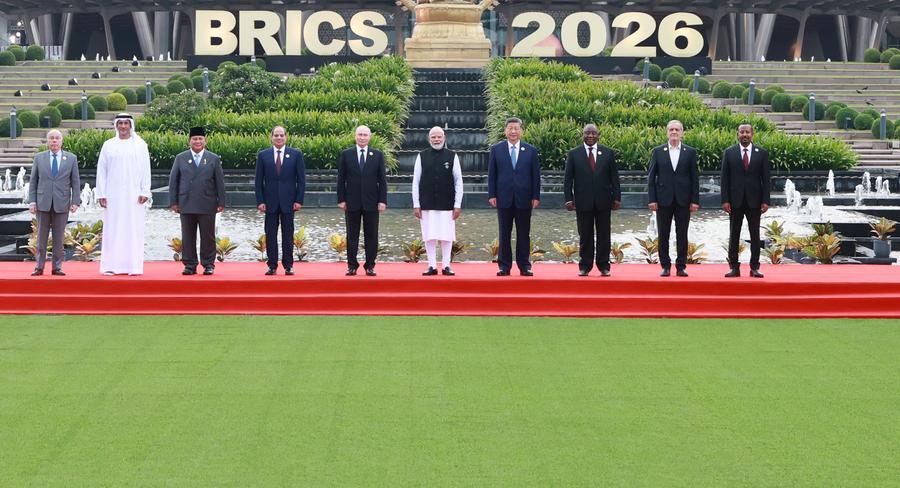
Leaders of the BRICS countries pose for a group photo during Session I of the 18th BRICS Summit in New Delhi, India, September 12, 2026. (Photo by Wang Ye/Xinhua)Leaders of the BRICS countries pose for a group photo during Session I of the 18th BRICS Summit in New Delhi, India, September 12, 2026. (Photo by Wang Ye/Xinhua)
First, China and India could benefit from recognizing each other not merely as nation-states but as civilizations with long and distinct histories, each possessing a civilizational character shaped over centuries. A clearer mutual understanding of these civilizational traditions can help both countries build a more solid foundation for cooperation on diplomatic, economic, and cultural issues, including in their engagement with the broader Global South.
Such understanding is best built through sustained civilizational dialogue among scholars, thinkers, lawmakers, and students, supported by active people-to-people exchange in business, media, and beyond. A more open and streamlined visa regime, together with expanded travel links, would help such exchange activities flourish.
Second, at the highest level, China and India could revive a structured economic dialogue to guide trade and investment cooperation, backed by currency swaps, digital payments, e-commerce, and closer engagement through multilateral mechanisms such as the New Development Bank.
Third, to maintain a comprehensive and forward-looking relationship, China and India should continue to prioritize scientific exchange that draws on their respective strengths, especially in artificial intelligence, space science, clean energy, and other emerging technologies.
Fourth, China and India could deepen trilateral engagement with Russia, a fellow BRICS founding member, through existing mechanisms. Given their respective strengths across the Global South, the three countries could also explore flexible cooperation formats with other Global South partners to advance progress in infrastructure, industrial development, financial inclusion, resource development, education, and other areas of common interests.
Finally, China and India are well placed to foster dialogue on connectivity. Recent volatility in the Middle East, including disruptions to the Strait of Hormuz, a major global energy transit chokepoint, has underscored the value of diversifying trade and energy transit routes across the Eurasian landmass. China and India could work with other Eurasian partners to support land and maritime corridors that strengthen trade, investment, people-to-people exchange, and energy security.
Future cooperation could therefore focus on improving connectivity, logistics efficiency, and trade facilitation, while also managing the development priorities and interests of participating countries. New routes and connectivity opportunities are attracting growing international attention. China, India, and other countries can monitor these developments and explore areas of mutually beneficial cooperation in accordance with international law and relevant international frameworks.
As the world undergoes a period of significant geopolitical transition, China and India have a genuine opportunity to help BRICS play a more constructive and forward-looking role. New Delhi and Beijing can align their positions so that BRICS is better equipped to help tackle shared global challenges such as energy and food security, public health, financial stability, digital development, and climate change.
The 18th BRICS Summit concluded successfully in New Delhi, with the adoption of the New Delhi Declaration. In his speech at the summit, Chinese President Xi Jinping reviewed the 20-year development of BRICS cooperation and called on BRICS countries to be pioneers in advancing innovation-driven development, upholding peace and stability, facilitating mutual learning between civilizations, and reforming and improving global governance. These principles provide a broad framework within which BRICS countries can deepen cooperation and strengthen the mechanism’s role in addressing shared global challenges.
Building on this shared commitment, China and India can contribute to a more balanced and inclusive vision of global governance in which BRICS serves as an important platform for South-South cooperation, one capable of working alongside other major economies and regions, including Europe and the United States, in the shared pursuit of peace, stability, and mutually beneficial development.
The author is a veteran journalist specializing in foreign affairs. He previously served as editor of the India Narrative website and as strategic affairs editor at The Hindu.