


A New Chapter of Engagement in China-U.S. Relations

-

China moves swiftly to stabilize markets amid global financial turbulence
In a time of heightened uncertainty in the global trade environment and dramatic fluctuations in international financial markets, the timely and decisive action of China's state capital will effectively guide market expectations and mitigate the impact of external shocks.
2025-04-09
-

China to work with EU to promote sound, steady development of relations -- Premier Li
Protectionism leads nowhere, and only openness and cooperation represent the right path for mankind.
2025-04-09
-

Practical progress in bilateral ties urged
The talks came close on the heels of the meeting between President Xi Jinping and Indian Prime Minister Narendra Modi in Kazan, Russia, held less than a month ago. The meeting was described by Wang as a restart of bilateral ties.
2024-11-21
-
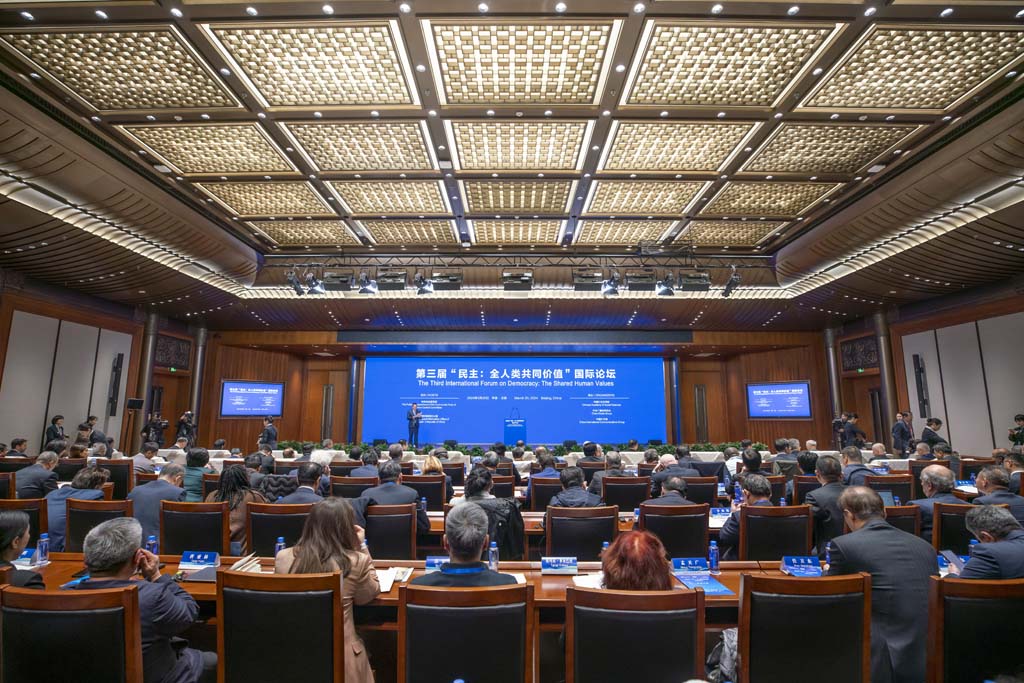
Beijing Hosts the Third International Forum on Democracy
The third International Forum on Democracy: The Shared Human Values, kicked off in Beijing on Wednesday. Over 200 guests from various countries, regions, and international organizations engaged in discussions to explore the essence of democracy and paths for mutual learning.
2024-03-20


By Abhishek G Bhaya
As Chinese President Xi Jinping arrived in Washington for a state visit from September 23 to 25, the significance of the occasion reached beyond formal meetings between the leaders of the world's two largest economies. The visit came just four months after U.S. President Donald Trump's visit to China in May, making the reciprocal visits within half a year a notable moment in the history of China-U.S. relations.
The timing is important. China and the United States remain major economic partners while also facing differences across trade, technology and other areas. Against this backdrop, sustained high-level engagement can help ensure that differences are managed through communication rather than being allowed to define the relationship.
That is also the direction signaled by the two sides following the May meeting. They agreed on a vision of building “a constructive China-U.S. relationship of strategic stability.” It means a positive stability with cooperation as the mainstay, a sound stability with moderate competition, a constant stability with manageable differences, and an enduring stability with promises of peace.
For relations between major countries, stability does not mean an absence of differences. China and the United States have different political systems, development paths, and strategic priorities. Nor should dialogue be understood as requiring either side to set aside its fundamental interests. Rather, regular communication can provide the means to understand those interests more clearly, reduce miscalculations, and identify areas where cooperation serves both sides.
Economic and trade relations are an obvious area.
The two economies remain deeply connected through trade, investment, and supply chains. Businesses on both sides benefit from stable and predictable conditions, while consumers and workers have a shared interest in an economic relationship that remains resilient. The trade discussions leading up to the visit have demonstrated the value of direct consultation in addressing differences and seeking mutually beneficial outcomes.
The longer-term task is to make such communication more regular and predictable. Trade and investment mechanisms, diplomatic consultations, and exchange activities between economic officials can help ensure that disagreements are addressed before they become larger obstacles to cooperation.

Chinese and American youths participate in a friendly game of ping-pong at the Stilwell Museum in southwestern China's Chongqing Municipality, January 16, 2026. (Photo by Chen Cheng/Xinhua)
The cultural dimension of the visit is also particularly meaningful. Alongside formal state ceremonies and talks, the program includes engagements centered on the history and cultural ties between the two countries.
Such activities may appear secondary compared to discussions on trade, but they highlight an important reality: Relations between countries are ultimately also relations between peoples.
For decades, students, scholars, businesses, artists, and ordinary citizens from China and the United States have built connections across borders. These links create familiarity and understanding that cannot be produced solely through official diplomacy. Keeping them open and expanding them can provide a valuable foundation for a stable relationship, even when governments encounter differences.
Young people, in particular, have an important role to play. In recent years, educational and cultural exchanges have brought tens of thousands of young Americans to China, while Chinese students and researchers have continued to engage with counterparts in the United States. Such exchange activities enable people to encounter societies directly rather than through assumptions or stereotypes.
This is why the current state visit should be viewed not simply as another high-level meeting, but as part of an ongoing process of engagement.
No single meeting can resolve every difference between two major countries. Nor should that be the measure of diplomacy. The more enduring achievement would be to maintain channels of communication, expand practical cooperation, and create greater predictability in a relationship with importance reaching far beyond Beijing and Washington.
The message of the visit, therefore, is perhaps best captured not by the differences that remain, but by a willingness to continue talking despite them. For China and the United States, engagement is not merely an option. Given the scale of their economies and global responsibilities, it is a crucial part of building a more stable and prosperous future for both countries and the wider world.
The author is a senior Indian journalist and international affairs analyst.